Writers at Sleep Authority are supported by a research team conducting in-depth research about the topics. The editorial team reviews them for accuracy and facts to ensure the most authentic and accurate content is published. Sleep Authority does not offer any medical advice, and you should not rely solely on our content for your course of treatment. Consult your medical professional to discuss any health concerns, chronic conditions, treatment options, or diagnoses.
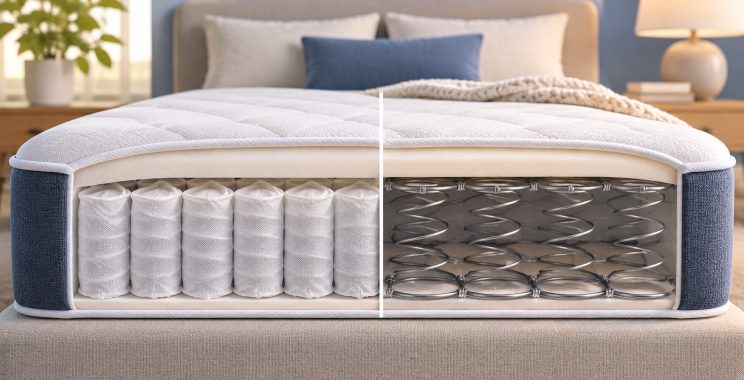
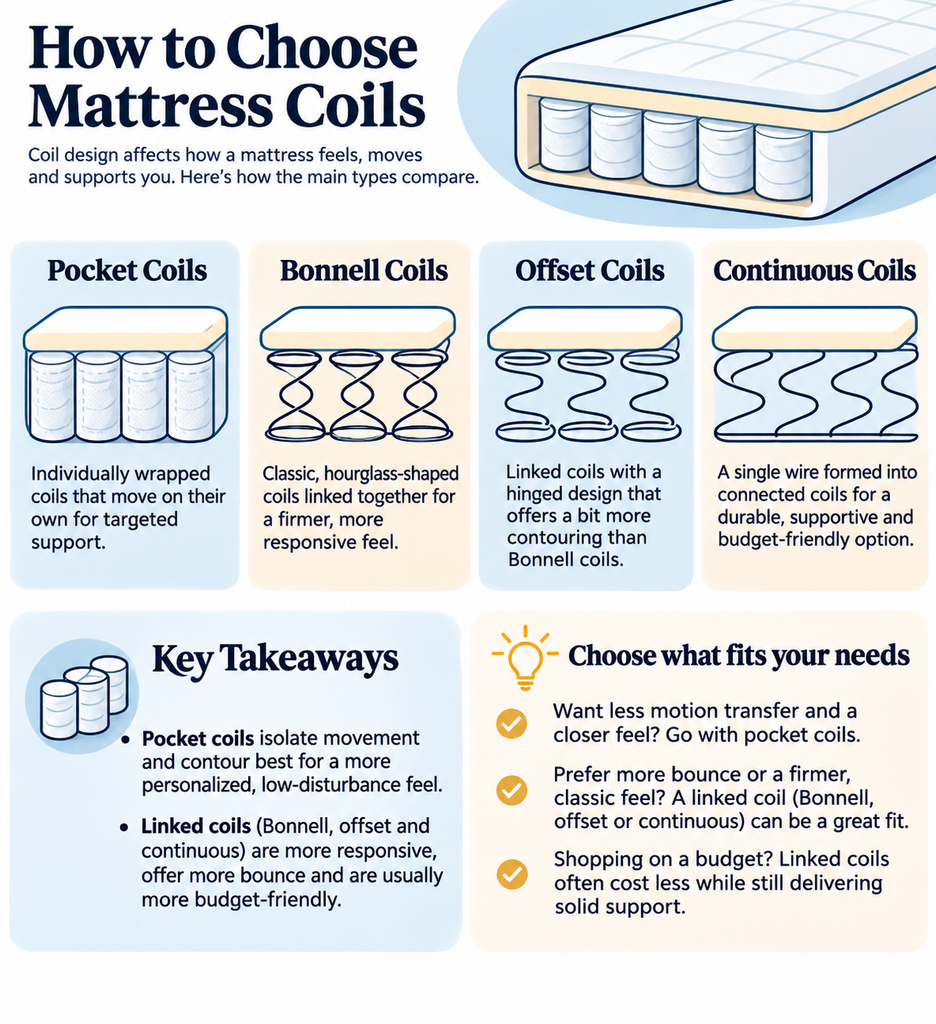
Match mattress coil types to motion and contour preferences, not to the price on the tag. If you share a bed, start with pocket coils. Each spring sits in its own fabric pocket, so a turn or movement from a partner stays local. Alternatively, Bonnell coils, offset coils, and continuous coils are tied together and usually cost less.
What mattress coils do
Mattress coils are steel springs in the support core of an innerspring or hybrid mattress. They compress under your weight and push back. That push is the bounce you feel when you sit down or roll over. The gaps between the springs also let air move, which is why a coil core usually sleeps cooler than a solid block of foam.
Coils do not set the feel by themselves. A thick memory-foam top can make a pocket-coil mattress feel plush. A thin top over linked coils can feel firm and bouncy. If you are deciding between foam and springs as a category, our foam versus spring mattress guide covers that choice, while this article is about the coil unit itself.
The four mattress coil types
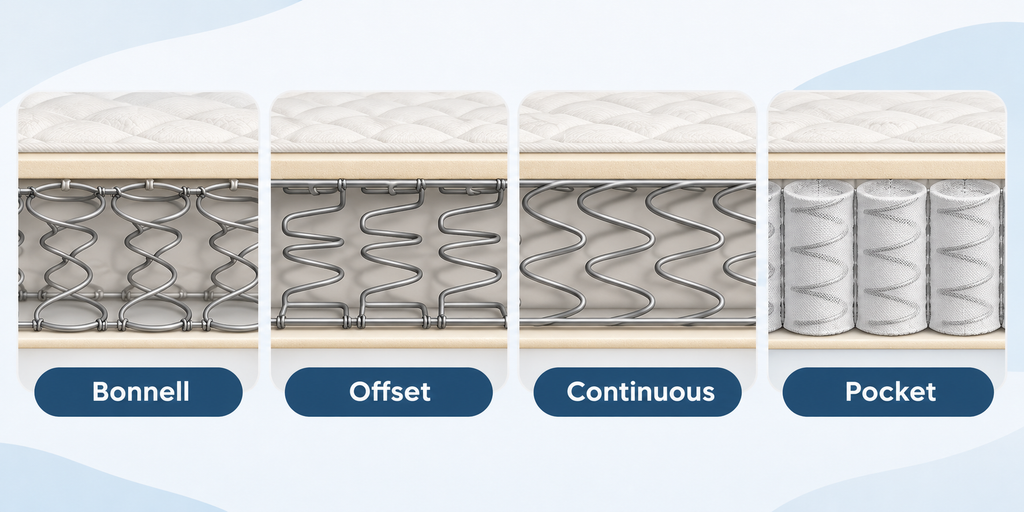
Four builds cover nearly every coil core you will see. Linked coils share movement. Pocket coils do not.
| Coil | How it is built | What you feel |
|---|---|---|
| Bonnell | Hourglass springs knotted at the ends and connected together with wire | Firm bounce, more motion transfer, often the lowest price |
| Offset | Hourglass springs with flattened ends, still tied together | More hinge and contour than Bonnell, some motion still travels |
| Continuous | One wire formed into rows of coils | Stable and durable, limited contour |
| Each spring in its own fabric pocket | Local movement, more contour, usually a higher price |
Bonnell coils
Bonnell coils are the oldest mattress spring still in wide use. The hourglass is wider at the top and bottom than in the middle, and each coil is tied to its neighbors. Because they move as a unit, the bed feels responsive, and a shift on one side can reach the other. The wire ties can also squeak as the mattress ages. Bonnell cores are a common way to keep an innerspring mattress inexpensive. They are a weaker choice if you and a partner wake each other up.
Offset coils
Offset coils keep the hourglass and the wire ties, then flatten the ends so the spring can hinge. That hinge lets the surface follow you a bit more than Bonnell does, and it can be quieter. The coils are still connected, so motion is reduced rather than removed.
Continuous coils
Continuous coils are formed from a single wire that runs row after row, held in place by connective helical wires. There are fewer loose ends that can loosen, which is why this build has a reputation for staying stable. The tradeoff is contour. A continuous unit feels even and firm, and it does not cradle a shoulder or a hip the way separate springs can. It suits a mattress that gets its softness from the comfort layers on top.
Pocket coils
Pocket coils, also called pocketed or Marshall coils, are wrapped one by one in fabric. The pockets are sewn or glued into a grid, and each spring compresses only where you press. That is the motion isolation couples are looking for, and it is why the surface can contour without the whole core collapsing into one hammock. Pocket coils cost more to build. They are the coil type in most hybrids sold now.
We recommend pocket coils when two people share the bed, because the fabric pocket keeps one person’s movement from pulling the neighboring springs. A linked coil cannot do that job as cleanly.
Gauge, count, and the edge
Coil gauge is the thickness of the wire. A lower gauge number means a thicker wire, and a thicker wire feels firmer and holds up under more load. A higher gauge number means a thinner, more flexible wire. Read the number beside the word gauge. Marketing lines that say “higher gauge” without a number are easy to misread.
Coil count is the number of springs in the core. Pocket coils are smaller than Bonnell coils, so a pocketed queen can list a much higher coil count without being a stronger mattress. Use the count only to compare two beds of the same coil type and size. A bigger coil count number does not, by itself, mean a better bed.
The mattress edge is a separate decision. Many hybrids add firmer coils, or extra rows of coils, around the perimeter so you can sit on the edge of the bed without rolling off. The Awara Classic Hybrid does this with two firmer rows of thick-gauge edge-support coils around individually wrapped coils. The Nectar Classic Hybrid uses two rows of reinforced perimeter coils around an 8-inch unit of individually wrapped coils.
How a hybrid uses those coils
A hybrid puts a foam or latex comfort layer over a coil core. The coil type is almost always pocketed. The inch count of the mattress often changes in the comfort layer, not in the springs.
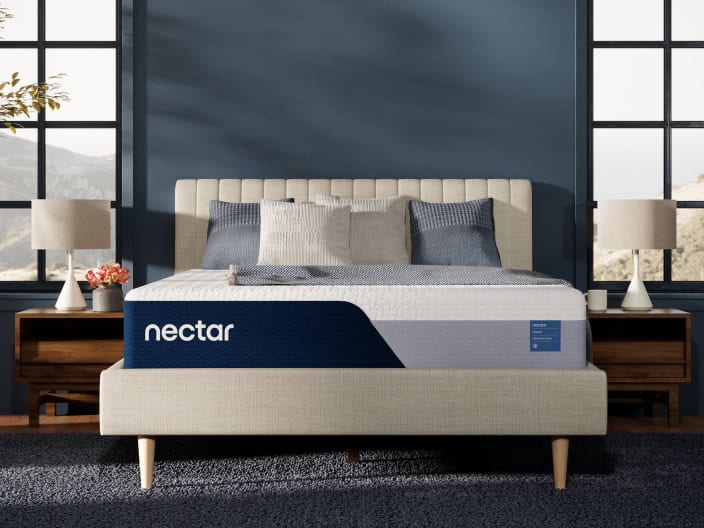
Nectar’s Classic Hybrid is 12 inches and is described as medium-firm. Its coil unit is 8 inches of individually wrapped innerspring coils. The Nectar Premier Hybrid is 13 inches, with twice the pressure-relieving memory foam of the Classic Hybrid, and it keeps that same 8-inch coil unit. Both include a 365-night home trial and a Forever Warranty™. If you do not want coils at all, the Nectar Classic memory foam mattress is a 12-inch all-foam bed with no spring unit.
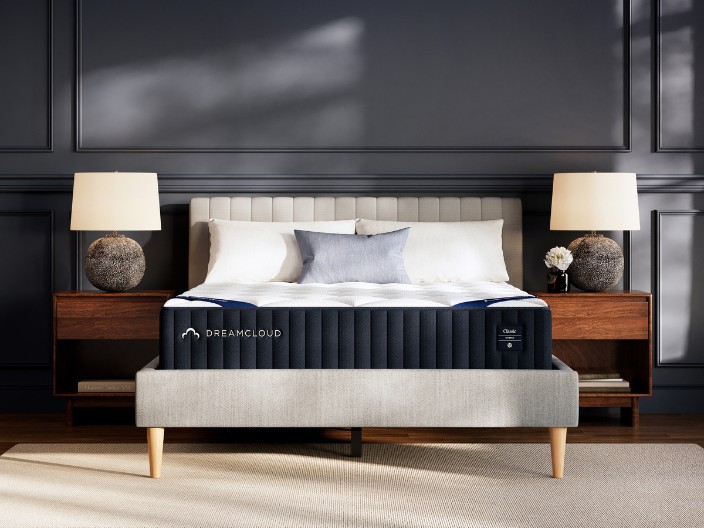
DreamCloud’s Premier Hybrid is 13 inches and medium-firm, with 8 inches of individually wrapped coils under a CloudQuilt euro top. The lineup comparison lists the DreamCloud Classic Hybrid at 12 inches, with 1 inch of memory foam over individually wrapped coils, and DreamCloud describes that model as firm. The DreamCloud Luxe Hybrid is 14 inches. As with Nectar, the extra height is comfort material over a pocket-coil core. DreamCloud includes a 365-night home trial and a Forever Warranty™.
Awara’s Classic Hybrid is 10 inches, with 2 inches of GOLS- and FSC-certified organic latex over individually wrapped coils. The Awara Premier Hybrid is 12 inches, with 4 inches of latex. Awara describes its latex layer as medium-firm. The extra inches are latex, not a taller coil. The trial is 365 nights, with a Forever Warranty™. We love this example because you can see the coil and comfort layers separately as they are shown on the product page. The pocket coils carry you, and the latex depth changes how much you sink.
Siena sells both builds, which makes it a useful contrast. The Siena Signature Memory Foam mattresses are all foam, with no coil unit. The Siena Signature Hybrid comes in 10, 12, and 14 inches, with individually wrapped coils under memory foam that are designed to reduce motion transfer. The 8-inch Siena Essential Hybrid uses an interconnected coil system instead, so it is closer to the linked coils described above. Choose Siena Signature Memory Foam when you want an all-foam bed at a budget price. Choose a Signature Hybrid when the reason you are shopping is motion control or airflow from a pocket-coil core. Siena’s mattresses come with a 10-year limited warranty.
Our memory foam versus hybrid guide compares those two builds. Mattress height, which is a different measurement from coil height, is covered in our mattress thickness guide.
How to choose a coil type
- If you share the bed or you want the surface to follow shoulders and hips, choose pocket coils.
- If you want bounce and a lower price or you sleep alone, Bonnell or continuous coils can be enough.
- If you want a step up from Bonnell without pocket-coil pricing, look at offset coils and test the motion for yourself.
- If you sit on the edge of the bed to get dressed, look for a reinforced perimeter, not just a high coil count in the center.
It’s worth noting that the comfort layer can hide a mediocre coil unit for a few months. If you press on the edge of a mattress then stay still while someone else moves on the other side, that can tell you more than the coil count. Also, use the trial the mattress comes with. Nectar, DreamCloud, and Awara give you 365 nights. Siena’s trial is 180 nights across its foam and hybrid mattresses.
Frequently asked questions
What are pocket coils?
Pocket coils are steel springs wrapped individually in fabric. Each spring moves on its own. They are the usual core in a hybrid mattress, including the Nectar, DreamCloud, Awara, and Siena Signature hybrids listed in this article.
Are pocket coils better than Bonnell coils?
Pocket coils are better at motion isolation and contour. Bonnell coils are better when the priority is a lower price and a traditional bouncy feel. Neither is better for every sleeper, and preference and comfort are big factors.
Do more coils mean a better mattress?
No. Pocket coils are smaller, so the count runs higher than a Bonnell count in the same size bed. Compare gauge, coil type, and the comfort layers before you compare the number.
Do coil mattresses sleep hot?
The coil core itself sleeps cooler than solid foam because air can move through the springs. A thick memory-foam top can still trap heat. Read about the cover and the comfort layer, not just the coil type.
What coil type should a hybrid have?
Pocket coils. A hybrid is trying to combine a contouring top with a core that does not transfer motion. Linked Bonnell or continuous coils work against that second job. The hybrids from Nectar, DreamCloud, and Awara, and Siena’s Signature Hybrids, all use individually wrapped coils.