 Writers at Sleep Authority are supported by a research team conducting in-depth research about the topics. The editorial team reviews them for accuracy and facts to ensure the most authentic and accurate content is published. Sleep Authority does not offer any medical advice, and you should not rely solely on our content for your course of treatment. Consult your medical professional to discuss any health concerns, chronic conditions, treatment options, or diagnoses.
2026 Temperature Guide
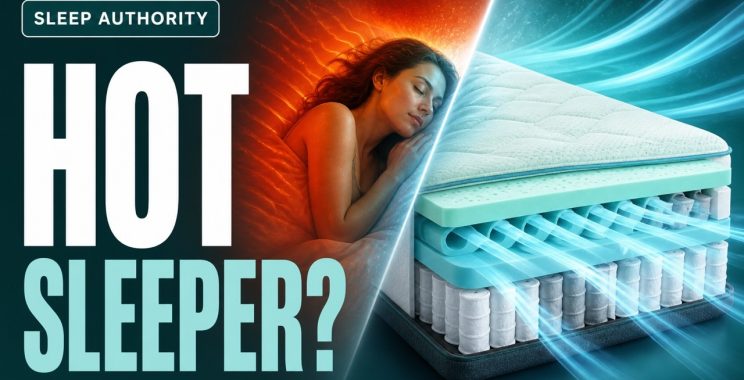
The best cooling mattress for hot sleepers in 2026 should move heat away from the body with airflow-friendly construction and breathable surface materials. Marketing words like “gel,” “arctic,” or “titanium” are secondary. If the core traps heat, a cool-to-touch cover only delays the problem.
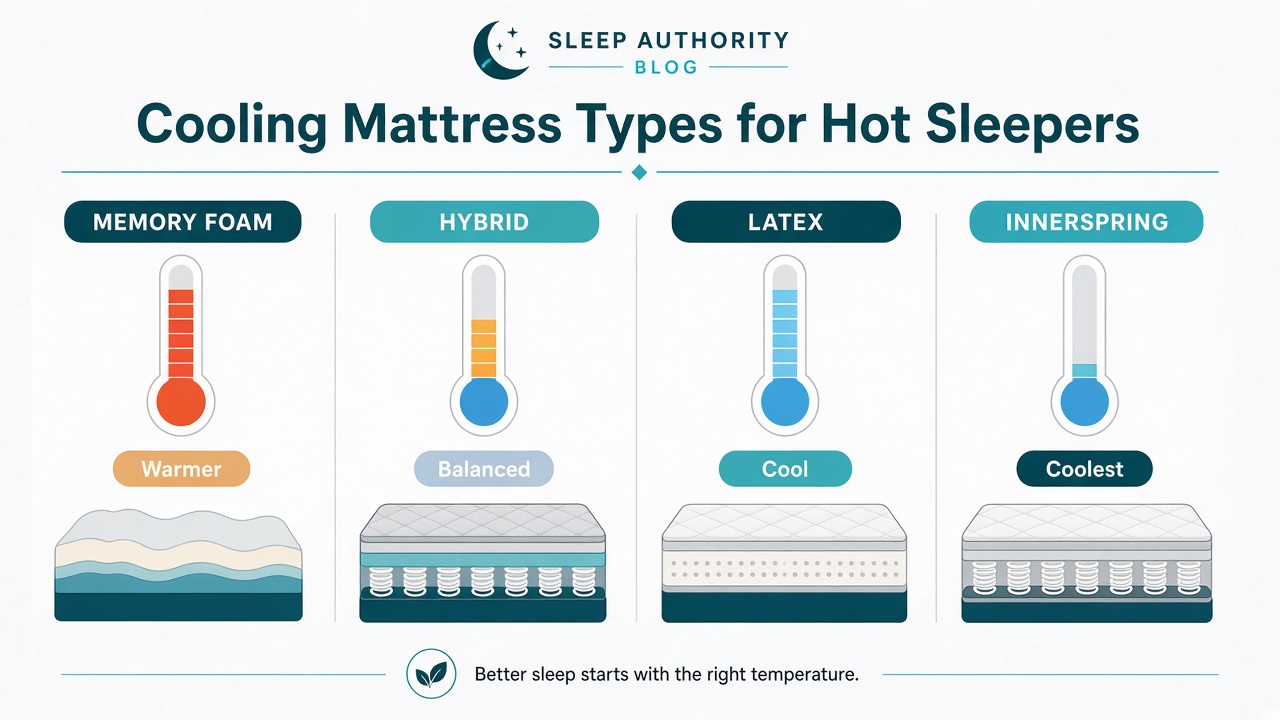
This guide expands Sleep Authority’s four-type comparison—memory foam, hybrid, latex, and innerspring—into practical tables you can use while shopping.
Bottom line
Most hot sleepers should short-list hybrids and latex first, consider innerspring when airflow is the top priority, and treat solid memory foam as a fit only when it is heavily ventilated and paired with a breathable bedding system.
Table of Contents
- Quick answer for hot sleepers
- Watch: four types compared
- Why mattresses trap heat
- Cooling comparison infographic
- Detailed type-by-type breakdown
- Cooling technologies table
- Build a cool sleep system
- Chooser tables by sleeper profile
- How to test cooling on a trial
- Frequently asked questions
- Key takeaways
Quick answer for hot sleepers
Watch: four types compared
The video shows how heat buildup differs across constructions and which cooling features deserve budget versus which ones are mostly first-touch theatrics.
Why mattresses trap heat
Heat accumulates when dense materials hug the body, reduce air exchange, and sit under non-breathable protectors or heavy bedding. Humidity makes the same mattress feel stickier. A cooler room helps every category—do not ask foam to overcome a 78°F bedroom alone.
The heat pathway
Body heat moves through comfort layers into the core, then out through the cover and bedding into room air. Block any stage and overnight temperature climbs. That is why construction (coils, latex openings, perforations) usually beats surface coatings.
Cooling comparison infographic
Detailed type-by-type breakdown
Memory foam
Excellent pressure relief, historically warmer. Newer open-cell and perforated foams improve airflow, especially in hybrid designs. Pure solid foam slabs remain the hardest category to keep cool all night for very hot sleepers.
Hybrid
Foam (or latex) comfort layers over coils. Coils create channels for air and usually provide a cooler overnight experience than all-foam equivalents with similar cushioning. Watch for thick, dense quilting that can re-insulate the surface.
Latex
Resilient and often naturally cooler than viscoelastic foam. Talalay and ventilated Dunlop designs can feel especially airy. The tradeoff is a bouncier, less “melting” hug.
Innerspring
Open coil cores move air well. Modern versions with better comfort layers can serve hot sleepers who disliked old hotel beds. Side sleepers should still confirm pressure relief at the shoulder.
| Type | Airflow | Pressure relief | Cooling outlook | Best for |
|---|---|---|---|---|
| Memory foam | Low–Mod | High | Warmer unless ventilated | Pressure relief first |
| Hybrid | Mod–High | Mod–High | Strong default | Most hot sleepers |
| Latex | High | Mod–High | Often cool | Hot + bounce preference |
| Innerspring | High | Low–Mod | Often coolest core | Airflow maximalists |
Cooling technologies table
| Tech | Mechanism | Impact level | Editor note |
|---|---|---|---|
| Coil / open cores | Air movement under comfort layers | High | Best foundational strategy |
| Perforated foam | Channels through foam | Medium-High | Look for real perforations, not claims only |
| PCM covers | Phase-change surface buffering | Medium (initial) | Great first feel; not a full fix |
| Gel infusions | Alters foam thermal feel | Low–Medium | Easy to overhype |
| Copper/graphite stories | Claimed conductivity | Variable | Judge with construction first |
Build a cool sleep system
- Mattress with airflow-first design
- Breathable waterproof protector (avoid vinyl-like barriers)
- Percale, linen, or performance sheets
- Lighter duvet or layered blankets you can peel
- Room temperature and humidity management
Infographic panel: system stack
Room climate → breathable bedding → breathable protector → airflow mattress. Weakness anywhere undermines the rest.
Chooser tables by sleeper profile
| Profile | Start with | Why | Secondary option |
|---|---|---|---|
| Hot side sleeper | Breathable hybrid | Cushion + coil airflow | Ventilated latex hybrid |
| Hot back sleeper | Hybrid or latex | Support without heat soak | Supportive innerspring |
| Hot stomach sleeper | Latex / firmer hybrid | Flatter feel + air | Innerspring |
| Hot + budget | Simple ventilated hybrid | ROI over PCM foam | Quality innerspring |
| Hot + wants deep hug | Perforated foam hybrid | Contour without solid core | PCM-covered ventilated foam |
How to test cooling on a trial
- Sleep 5–7 nights before judging; first night nerves skew heat perception.
- Keep sheets/protector consistent while testing.
- Note time-to-hot: immediate vs. after 2–3 hours.
- Check partner agreement—two bodies raise microclimate heat.
- If only the surface feels cool for 10 minutes, construction is not doing enough.
Frequently asked questions
What mattress type sleeps coolest?
Innerspring and many hybrids usually beat solid memory foam on airflow. Latex is also a top cooling category.
Are cooling sheets enough?
They help a lot, but they cannot fully rescue a heat-trapping core for very hot sleepers.
Do I need PCM?
Nice bonus, not the primary purchase reason.
Can a protector make me hotter?
Yes—especially non-breathable waterproof covers.
Key takeaways
- Construction > buzzwords for hot sleepers.
- Hybrid and latex are the most reliable everyday cooling picks in 2026.
- Cool the whole system: room, bedding, protector, mattress.
- Use the video + infographic to short-list before you spend.
Educational companion to Sleep Authority’s cooling mattress video.